Best Crypto Exchanges: How to Choose the Right Crypto Trading Platform
Choosing the best crypto exchange isn’t about finding “the #1 platform.”
It’s about matching a crypto trading platform (or cryptocurrency trading platform) to your location, experience level, and what you actually want to do: buy & hold, active trading, on/off-ramp, or advanced products.
This guide covers recommended crypto exchanges (with fee references) plus a simple checklist to help you pick the best exchange for crypto for you.
Important (age + legality): Most major exchanges require you to meet local legal age requirements (often 18+) and complete identity verification (KYC). If you’re under 18, don’t try to bypass rules, consider learning with market trackers, paper trading, or a parent/guardian-managed account where permitted.

How to choose the best crypto exchange
1) Can you legally use it where you live?
Before anything else, confirm the exchange supports your country/region and your situation (KYC, age requirements, supported fiat rails).
Don’t rely on social media, use the exchange’s official availability + legal pages.
2) Fees: maker/taker, spreads, and “instant buy” markups
Fees aren’t just the headline maker/taker rate. Watch for:
- Trading fees: maker vs taker (order book)
- Spreads: the hidden cost in the price you get
- Convenience fees: “instant buy/sell” can be priced differently than “pro/advanced trade”
- Withdrawal fees: vary by asset and network
Example: Binance publicly lists a standard spot rate for regular users (often shown as 0.10% / 0.10% maker/taker) with potential discounts depending on conditions.
3) Security and transparency
Look for basics like 2FA, withdrawal address allowlists, and a strong operational track record.
If transparency matters, Proof of Reserves can be a meaningful plus (though it is not the same as a full financial audit). Kraken explains how clients can verify in-scope balances using its Proof of Reserves process.
4) Liquidity and execution quality
Higher liquidity usually means tighter spreads and less slippage.
Large venues often rank high by volume/trust-score trackers (for example, CoinGecko’s exchange rankings and market share research).
5) Product fit
If you’re buying & holding: prioritize simple UX, reliable deposits/withdrawals, security defaults
If you’re advanced: prioritize order types, APIs, fee tiers, market depth
Also remember: derivatives carry higher risk than spot.
Best Crypto Exchanges
Binance: Best overall
Binance is often chosen for its deep liquidity, huge asset selection, and a wide product suite (spot, earn, etc.).
It’s also typically competitive on spot fees: Binance’s fee schedule lists a standard spot rate for regular users (commonly shown as 0.10% / 0.10% maker/taker) with discounts for certain conditions.

Pros: Strong liquidity and broad markets and competitive spot fee schedule
Cons: Not available everywhere; product access varies by region
Who should choose Binance: users who want one platform that can scale from beginner to advanced (where legally available).
Watch-outs: availability varies by country; always confirm local support and rules.
Bybit: Best for advanced traders
A trading-first exchange with detailed fee tiers and public transparency materials like Proof of Reserves.

Pros: Detailed fee documentation (incl. VIP tiers; updated Nov 15, 2025); publishes Proof of Reserves materials and audit docs; highlights cold-storage protections.
Cons: Can be complex if you only want simple buy-and-hold; product access varies by region.
Best for: Active traders who care about pro UX, fee tiers, and transparency signals.
OKX: Best for pro tooling + fee tiers
A feature-rich exchange geared toward active traders, with tiered fees and a broad product suite (availability depends on region).
Pros: Tiered spot fees; clear VIP/Regular tier structure.
Cons: Notable U.S. compliance enforcement history tied to an operator affiliate (AML case), so jurisdiction and counterparty-risk comfort matter.
Best for: Experienced traders who want pro tooling + fee tiers (and have confirmed OKX is supported where they live).
Watch-outs: derivatives carry higher risk. Also, compliance and availability can vary by jurisdiction—pay attention to regulatory history and where the exchange is legally accessible. For example, Reuters reported a 2025 U.S. case involving OKX’s operator and AML violations.
Coinbase: Best for beginners (US)
Coinbase is widely considered beginner-friendly due to its UX, fiat onboarding, and compliance posture in many markets.
Coinbase explains its maker/taker concept for Advanced trading and lists fee ranges depending on volume and order type.
Pros: Very approachable UX and clear maker/taker explanation for advanced trading
Cons: Fee levels vary by tier and trade style; can be pricey for small, frequent trades
Who should choose Coinbase: first-time buyers who want simplicity and strong mainstream integration.
Watch-outs: fees can be higher than pro-first exchanges depending on how you trade, always check the current tier/rate.
Kraken: Best for transparency-focused users
Kraken is known for a security-first brand and a strong push on transparency via Proof of Reserves, letting clients verify assets backing certain balances.
Kraken also clarifies that trading fees can vary by volume, pair, and maker/taker, ranging (by their support docs) from negative rebates in some cases up to higher rates depending on conditions.
Pros: Proof of Reserves program and public explanations. Trading fee details depend on volume/pair/order type.
Cons: Different fee experiences depending on “instant” vs pro trading paths
Who should choose Kraken: users who value transparency tooling and a security-forward narrative.
Watch-outs: “instant buy/sell” flows can carry different fee structures than pro order-book trading (always compare paths).
Bitstamp (and Gemini for US users): Best for “regulated, long-running exchange” vibes
If your priority is a more traditional feel, clearer fee pages, and a long operational track record:
- Bitstamp’s public fee schedule shows tiered maker/taker pricing (e.g., 0.30% / 0.40% under certain volumes, decreasing with higher volume).
- Gemini provides an ActiveTrader maker/taker fee schedule and explains how liquidity-taking vs liquidity-making works.
Best for: users prioritizing longevity and straightforward fee schedules
Watch-outs: asset selection may be narrower than the biggest global exchanges.
FAQs: best crypto exchange questions people actually ask
What is the safest crypto exchange?
No exchange is risk-free. “Safer” usually means strong security controls, transparent operations, and clear compliance in your region. Proof of Reserves can improve transparency (example: Kraken).
Which exchange has the lowest fees?
It depends on your volume, order type (maker vs taker), and whether you’re using “instant buy” vs pro order-book trading. Always verify the exchange’s current fee schedule (examples: Binance, Bybit, Bitstamp, Coinbase help pages)
Should I leave crypto on an exchange?
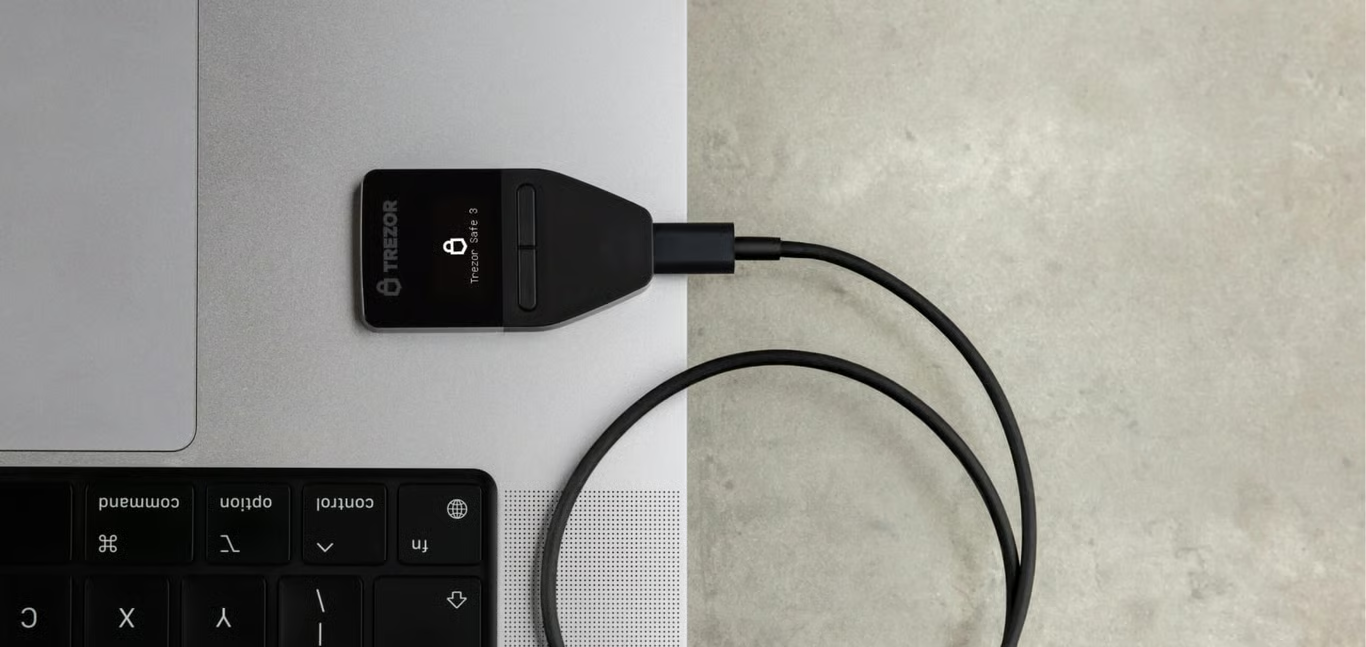
Many people keep only what they need for near-term trading on an exchange and move long-term holdings to self-custody. But self-custody has its own risks (seed phrase loss, phishing). The reason this question matters is real: major failures like FTX’s 2022 collapse showed that exchange risk can be catastrophic.
Bottom line: the best exchange for crypto is the one that fits your use case
If you want a fast shortcut list of recommended crypto exchanges:
- Global all-rounder (where available): Binance
- Beginner-friendly on-ramp (U.S.-leaning): Coinbase
- Transparency tools: Kraken
- Advanced trading-first platforms: Bybit / OKX (after confirming legal access + your own risk comfort)
- Straightforward fee pages + long-running brands: Bitstamp / Gemini
No matter what you pick: avoid keeping more on an exchange than you can afford to lose, use strong security (2FA + withdrawal allowlists), and learn wallet safety before you scale up.
Not your keys = not your coins
Learn more about how to protect your assets in this crypto wallet article series here.
All for information purposes only and not to be considered investment advice. You should do your own research before making investment decisions. Kaito is not a financial advisory entity and will not be responsible for any investment decisions you make.
- Follow me on X: https://x.com/kaitoxbt
- My youtube channel: Youtube
- My telegram channel: Telegram
- Crypto exchange you should use: Binance - Bybit